Thursday, February 20, 2014

Would paid advertising and social media go against Sriracha's brand image?

It was named best-tasting hot sauce by Cook’s Illustrated, and is frequently featured on the Food Network and popular TV shows such as The Simpsons. Twenty million bottles were sold in 2013, and it was the subject of a highly praised documentary which was released the same year. It probably comes as no surprise that Sriracha (also known as “rooster sauce”) is one of the fastest growing food companies in the United States. What may surprise you is that it has reached its iconic status without a single paid advertisement.


You’d probably be hard-pressed to find an iconic product that got to where it is today without any paid advertising. Sriracha doesn’t even have a Facebook or Twitter account, and they haven’t updated the website since 2004. The reason behind the company’s decision? One of them involves production limitations. David Tran, owner and creator of Sriracha, only uses chili peppers obtained from Underwood Family Farms, about an hour north of L.A. This is done in order to avoid fluctuating prices with larger suppliers, and also to ensure a fresher product. Smaller farms, however, mean less product, and the company already has a hard time keeping up with consumer demands. Tran chooses not to advertise because “we can’t promise something that we don’t have.” He’s also known for his extreme modesty, which probably has something to do with the company’s lack of online presence. 


Taking all of this into consideration, I can’t help but wonder where Sriracha would be if the company chose to work with larger suppliers, invest in paid advertisements, and utilize social media. Would advertising efforts go against their brand image? Would it damage their reputation? I think that one of the best parts of the product is the fact that it maintains the humble image it’s had since Tran first created it. It’s also one of the things that, I believe, contributes to the company’s increasing sales. The lack of advertising generates a certain degree of curiosity amongst people who may not have tried it. It creates a greater sense of community amongst those who use it. Lots of people have even described it as being a cult following. 


What do you think of Sriracha’s decision to not advertise? Would advertising and utilizing social media be beneficial or harmful to the brand?

Build With Chrome

Has the release of THE LEGO® MOVIE made you wish you still had your giant collection of colorful plastic bricks? Want a huge kick of nostalgia?


Google Chrome and LEGO have teamed up to make way to not only build with the studded bricks without the risk of stepping on one with bare feet, but be social and interact with Google Earth! The effort was/is being used to promote LEGO, Chrome, Google+ accounts, and of course, THE LEGO® MOVIE. If you ever played with LEGO as a kid this is really worth checking out. This is definitely a prime example of creative projects that did not start off as an advertisement, but turns into something worth people's attention. So keep on using your imagination and creating even if it's not for a client, you never know what you'll make or how it will be used in the future.

#WHATSTHERE

This 60 second advertisement for the 2014 Winter Paralympics shows viewers just how amazing these athletes really are. The ad starts out with a wide view almost hiding the whole image from the viewers. Doing so makes viewers feel as though that are simply watching the Winter Olympics. Its not until halfway through the ad does the image get larger therefore showing the viewers exactly which winter Olympics they are advertising for.


Whats most interesting is that at the beginning of the video you would never know that these people are disabled in any way. At the end of the advertisement it says, "It's not whats missing, it's whats there." These seven words do an amazing job of summing up everything these althletes live by.

Esurance Save 30

Everyone in world knows the Super Bowl is a huge event. Even countries that don't know what football is know about the Super Bowl, and even when the game doesn't give you much to talk about for the weeks after the commercials will. One of the biggest commercials from this year's Super Bowl didn't come till minutes after the game. Whether viewers stuck around to watch the ad or not, they probably heard about it in the following days. 


The Esurance Save 30 ad did what advertisements should do. They took a simple idea and made sure that everyone knew about it. Esurance is an online insurance agency that started with a simple idea: insurance online with less paper. They also started by using cartoons as advertisements. Since then they've taken a step in a different direction and have been using John Krasinski (The Office) to narrate their ads. With this ad Krasinski became the face of the company as well, even though his celebrity status might get ignored in the wake of the ads huge results. 

Advertisers claim to have saved 1.5 million dollars by airing the commercial minutes after the Super Bowl ended instead of during the game, and offered to give those savings to one lucky twitter user who used the #esurancesave30 hashtag. According to Time Business 200,000 entries came in only a minute after the commercial aired. 24 hours later there would be another 2 million entries to go along with those. Esurance's twitter following also exploded from 8,900 to more than 110,000. Esurance made a contest that had huge stakes so easy to enter people felt like it would be stupid not to sacrifice a tweet and enter, and the company saw a huge awareness payoff thanks to it.


For Your Eyes Only

"My first, I was 16."

"I was like a freshman, probably."

"I wanted it for a very long time."

"I lost it in the woods."

"I want it." "I need it."

Of course, all of these quotes are talking about cell phones. AT&T is currently promoting their AT&T Next℠ plan which includes an internet video ad that starts off with these implicative hook statements. The young, tattooed actors delivering racy lines was shown on a website whose audience are primarily males, ages 18 to 34 years old. After these edgy statements, the ad then reveals that they are in fact talking about their cell phones. You will have to trust me however. There is all but no trace of the ad to be viewed on further inquiry anywhere, unlike other current and past AT&T ads.


Audience segmentation may not be new, but the actively holding back an ad from the greater public is something that many of us don't consider. With such a large clientele base, companies like AT&T can avoid negative associations and controversy from non-prime prospects with strategies like this. The ever increasing levels of control advertisers have over who is exposed to a message can lead to many great things. Who knows, we might see a day when no one thinks how pointless or offensive that last ad they saw was since you will never see an ad made for another type of person.

Stage Your Own Winter Olympics


With the Winter Olympics occurring every four years, views look forward to the opportunity to be dazzled by their favorite athletes from all over the world. Its the chance to come together and cheer on your country in their quest for gold. In terms of advertising, the Winter Olympics are a time for companies to gain recognition as sponsors of this international event. Samsung, an electronic company from South Korea, has utlilized the 2014 Winter Olympics as their chance to not only relate to viewers but also to gain brand awareness for the quality and services they offer throughout their electronic devices.


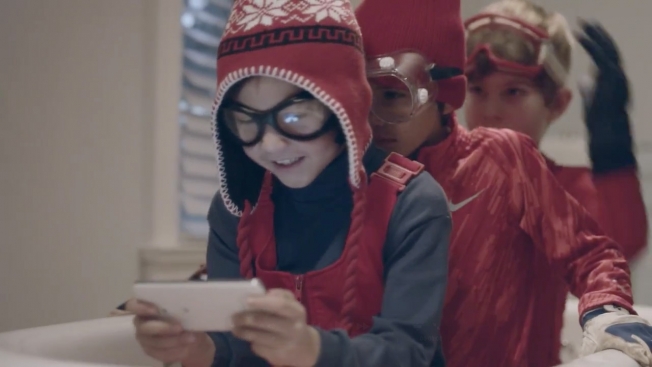
In this advertisement, Samsung is promoting their Galaxy line by visually expressing ways in which both kids and even adults can become inspired by playing out their favorite events all within the comfort of their homes. Whether it's becoming a Bobsled Olympian while sliding down a mountain in the bathtub, or skiing down your very own steps right to a gold metal, Samsung promotes the imagination that not only they possess as a company, but also their consumers.

Packaging Trends: Why to keep the box after it's opened.

Packaging has been a very important aspect of brand identity for quite some time. As a result of implementing more digital oriented content for entertainment media and software, packaging has become a smaller focus for some companies. Before the evolution in music technology from compact disc to MP3, there was always a very artistic and important role that packaging design had for this medium. Opening up the booklet and album cover for a CD was an entertaining way of interacting with the album, by placing a visual aspect to correspond with the audible elements that the album gives off. This was an even bigger deal when records were popular, mostly because of how large of an area they had to work off of, but there was also a very timeless idea behind records. They were collectables because of some of the artistic elements that they have implemented, but usually records contain other pieces of visual aids, such as posters and stickers. Even movies and software have been replaced by its digital downloaded counter part.


Despite the dwindling need for packaging these entertainment items, there is still a great need for some companies to create and implement unique packaging to give brands an identity that can be utilized in  store fronts. One more obvious brand that designs clean, crisp packaging the represents their brand perfectly is Apple. After purchasing an item from the Apple store, people can spot the product from a distance. Some of their larger products, such as iMacs, MacBooks and MacPros have all been placed into a carrying case that carries all of the elements and instructions to the product. This makes it easy for the consumer to carry it out of the store, while displaying the product to everyone around them on their way back to their transportation or home. This is a great strategy that Apple uses to turn their products into walking advertisements. This idea has come a long way since the original packaging for the first mac computers. Altogether, this evolution in their packaging has been a large role in Apple's brand. This trend has also become more popular in many other products as well. Food and beverage packaging are another huge portion of companies that utilize packaging in this manner. Therefore, despite many companies and brands going paperless with their products, there is still a great need and desire to revolutionize packaging for consumers.
128k-Mac-packaging-1-sm.jpg
Original Mac Packaging

Check-Out-The-Cool-Box-Holding-Your-2012-iMac-2.jpg
New iMac Packaging

FDA: Cigarettes are "Bullies"

Anti-smoking ads are notoriously clever and sometimes disturbing. In a recent TV spot by the FDA, they take a new twist on the impact of cigarettes, comparing them to a high school bully that pushes you around and manipulates you. In this ad, a little man (with a ridiculous mullet) won't leave a certain teenager alone. He says things like "We're going for a walk" or "we pause the movie when I say we do" and drags him around from place to place by the neck. When I first saw it, I had no idea what was going on, which was probably the intent. But as the little man climbs between the teenagers fingers at the end and the narrator states "Cigarettes are bullies", the entire ad clicked for me. It was very creative and made me think, and I enjoy seeing the powerful metaphors that the FDA and other anti-smoking campaigns create.


Wednesday, February 19, 2014

The Future of Print Advertising


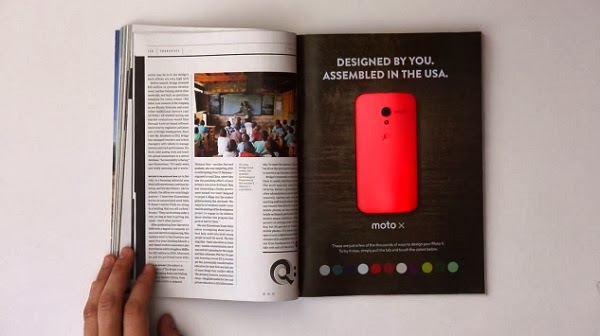
This past January, Motorola ran an interactive ad campaign that took print advertising to a whole new level. The full-page advertisement was printed in approximately 150,000 copies of Wired magazine, and combined paper-thin batteries, LEDs, buttons, and plexiglass in order to demonstrate the customizable color feature of the new Moto X phone. 


Design Elements


The ad, with the exception of its electrical components, is simple in design, and utilizes white space in order to bring the reader’s focus to the center of the page, where the LED-lit phone is featured. The phone itself is framed by minimal copy, which creates not only balance, but also contrast due to the white lettering layered over a dark, woodgrain background. Color-coded buttons at the bottom of the page also provide some contrast and complementation.


In My Opinion…


Motorola’s ad was a huge success, design-wise; it’s visually stunning, highly engaging, and unforgettable. I can’t wait to see what’s next for this medium, and I’m especially eager to see how the company’s competitors will react. What do you think? Are battery-powered, interactive ads the future of print advertising?

Want to read more about this campaign?


Coca-Cola


The competition between the competing companies Pepsi and Coca Cola is nothing new.  However, it has been discovered that Coca Cola’s profits have been going down.  The CEO, Muhtar Kent, believes social media and marketing is the best course of action.  Is it possible that this "best course of action" may have decreased sales from the beginning?  Coca Cola aired a controversial ad during the 2014 Super Bowl.  Though this ad may not seem controversial to some, the strategy of placing multiple languages in the advertisement has been a hot topic.  America is considered the melting pot of all cultures, which this ad conveys.  However, some believe it supports emigration.  Despite this ad, Coca Cola plans on increasing their media spending to $1 billion by 2016.  With this budget they hope not only to increase sales in North America but globally as well.  Coca Cola has been successful in producing global ad campaigns such as the Share a Coke campaign which was launched in Australia.  This campaign increased the declining sales in the country of Australia by placing names on Coca Cola cans.  With this new budget, there are multiple advertising tactics that could be utilized in order to increase sales. 


"Coca-Cola Boosts Marketing Spend as Demand Slows |News - Advertising Age." Advertising Agency & Marketing Industry News - Advertising Age. N.p., n.d. Web. 19 Feb. 2014.