With the release of the newest Call of Duty game, a proper advertisement is in order. Modern Warfare 3 under Activision, created a commercial that is aiming to make this their biggest game release yet. Appealing to their loyal "gamers", they are also trying to reel in many new customers. The ad also recalls the slogan it used in past advertisements, "There's a soldier in all of us".
From Adweek, "When Kobe Bryant and Jimmy Kimmel showed up in Call of Duty: Black Ops, it seemed both pleasantly incongruous and entirely apt. They brought star power without it seeming gratuitous, or breaking the internal logic of the ad. They, like us, simply escaped and became soldiers." Activision, with their new explosive trailer directed by Peter Berg, brings in Jonah Hill of Knocked Up fame, together with Sam Worthington from Avatar in an action-packed, dramatic trailer. Worthington is described as "the Vet" while Hill is perceived as "the n00b", or newbie. The ad starts off with Hill following Worthington through different cities such as New York, Moscow, and Paris, trying to learn the ropes. We have humorous dialogue paired with intense shooting action. Of course, in the end, Hill becomes a seasoned vet and Worthington is surprisingly impressed.
It is a shot in the right direction if Activision wants to truly appeal to both demographics- the "vets" of the Call of Duty franchise, and the "n00bs" or new players. It's interesting and funny, and they want you to know that YOU can get in on the action, no matter what your skill level or knowledge. For a company that has, in the terms of video games, an older franchise, it is important to appeal to new customers. The involvement of these actors, who are suppose to represent both demographic of gamers, creates a fun and inviting atmosphere that is appealing to both. Would you agree?
Source: Adweek
Monday, November 7, 2011


'Real' Models for Advertising Campaigns

In my last post, I discussed some negative consequences of interactive advertising and how one man ended up in front of a judge for his uncontrollable actions towards a cardboard female of a sunglasses advertisement in a drug store. This type of virtual advertising came back to my focus after reviewing a collective series of ads from a website that presented 'real' consumers of products used to connect with the audience.
One example given from Rediff.com, discussed Ford Motor Company's latest campaign titled, "Swap Your Ride," where the one of America's oldest car dealers uses real people to sell an experience. The campaign is aimed at those who have never set foot in a Ford dealership by providing actual footage and testimony from participants of rival car brands. Ford let these participants ride around in one of their new car models for 10 days to ask for their opinions. The dealer has creatively devised a way to bring in the Ford avoiders who have not experienced a Ford 'Ride' ever in their life.
I think this is a wonderful technique used for pulling in new customers as well as re-affirming a current Ford customer's decision on a one of people's largest life purchases. Most people do not buy cars very often and also tend to remain loyal to a particular make or vehicle. This type of interaction with real consumers helps Ford remain a reputable car maker in the industry and also save money by hiring an expensive advertising agency to deliver a message blatantly obvious to those who have tried Ford's products.
This article was originally found on www.rediff.com.
Vampire's 2012 Volvo Up For Grabs

With the upcoming premiere of the final installment of the Twilight saga, Volvo is monopolizing on an opportunity to promote their 325hp Volvo S60 T6 R-Design. The concept of the ad is to firstly promote the Twilight movie, but secondly couple it with an opportunity to win "Edward's car", the Volvo and you have a contest that will send "Twihards" into a frenzy. However, how effective will this promotional strategy be? Is Twilight really that big of a deal to inspire someone to enter to win the actual car? Or do preconceived stigmas attached to the franchise alienate certain audiences?
Of course an opportunity to win a free car is hard for most people to pass up. But what if it's a Twilight car? I for one am not a fan of the Twilight franchise, so I tend to tune out the previews for the upcoming movie which is where this ad is featured. I feel like Volvo's attempt at promoting their new car may be successful to younger high school audiences, but the opportunity is only valid to those eighteen years of age or older, which limits who would want to enter. On the flip side however, maybe the Twilight name won't be a contributing factor to people's decisions to enter for a free car or not. It may just be a matter of opinion.
To watch the full length ad click here.
Saturday, November 5, 2011
Antispokesman makes a great spokesman
I've never actually seen an advertisement or commercial for Columbia Sportswear...or at least I don't remember seeing one. But when I read about the new campaign for their Omni-Heat Electric line of outwear clothing, I was not only shocked by how crazy Wim Hof is, but also at how creative the campaign is. The New York Times describes Wim Hof, a Dutchman who has trained his body to overcome subzero temperatures while running, hiking, swimming, etc., as the antispokesman for Columbia Sportswear due to the fact that he isn't wearing any Columbia sportswear during the ad. In fact, he isn't wearing much more than a pair of shorts.
In a commercial that will only be posted online, Columbia Sportswear explains that clearly the average person cannot do what Hof can, and therefore must use their Omni-Heat Electric products.
The antispokesperson is a clever idea and I think it will be extremely effective in their campaign. However, I think they should do more than just post the commercial online and give it some air time in order to reach a broader range of people.
For the entire article: click here !!
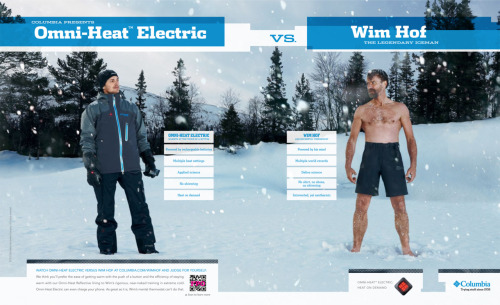
In a commercial that will only be posted online, Columbia Sportswear explains that clearly the average person cannot do what Hof can, and therefore must use their Omni-Heat Electric products.
The antispokesperson is a clever idea and I think it will be extremely effective in their campaign. However, I think they should do more than just post the commercial online and give it some air time in order to reach a broader range of people.
For the entire article: click here !!
Thursday, November 3, 2011
Ad Swapping
 Online video websites are trying to come up with effective ways of placing advertisements on their pages. Oftentimes, the viewer simply wants to watch their television show or video clip without interruption. In fact, it doesn’t seem much of a stretch to say that the idea of having to watch an advertisement either before or during the video they’ve selected is enough to infuriate the viewer. One new approach to this problem is ad swapping.
 Websites like Hulu and Youtube have started testing out a new system that allows the viewer to decide for themselves which ads they will get to see. Hulu is utilizing its “Ad Swap” feature, which enabled the viewer to choose from a list of substitute ads if they do not want to view the pre-selected one, while Youtube has put forth a system in which the viewer gets to select between three different ads. Despite these new attempts at injecting ads into online video, the results still show that the “Skip this Ad” feature is the most popular choice.
In fact, there has been little positive response to the ad swapping idea. The general problem with it is that by the time the viewer has decided which ad they wish to see, they could have already been halfway through an ad that was selected for them and started automatically. This ad swap concept provides the viewer with a choice, but it still slows them down in achieving their ultimate goal, which is: to watch the video that they selected. I think that the best choice for everyone involved is to give the viewer the option of watching the ad or not. This way the viewers who are actually interested in the product will watch, while those who aren’t won’t become upset and start associating the product with negative emotions.
Adobe Systems boosts Advertising
 Adobe Systems is an American computer software company founded in 1982 and headquartered in California. The company has historically focused upon the creation of multimedia and creativity software products.
Recently, the company has acquired a privately owned advertising company called "Auditude" to increase its advertising platform. Video advertising has been a new, creative, and innovative way to market products, services, and events. Within the month of September, Americans watched 6.8 billion online video ads where the company "Auditude" streaming 344 million of these. That made the company the seventh-largest source of such ads in the US and the fifth largest video advertising network- now making Adobe responsible for all of these advertisements.
"Auditude" offers a wide range of integrated advertising system for video for computers, phones, and tablets. With this acquisition, Adobe plans to combine "Auditude" platform with its own Flash Media Server and Pass products and integrate the company with Adobe Digital Marketing Suite. Overall, this acquisition places Adobe Systems high in the video advertising market ratings.
For more information, click here.
Sunday, October 30, 2011
Celebrating 100 years with Chevy
Celebrate a rousing Happy Birthday to GM's Chevrolet brand, marking 100 years on November 3rd. What's a better way to celebrate 100 years but with a little nostalgia? GM has created an ad to go along with their 100 year celebration. It first premiered during Game 1 of the World Series, after some careful planning and coordination. With Chevy's long-standing association with the sport and the celebration of American culture to go along, it was a no-brainer to place the commercial during the World Series.
The Ad opens very simply, with a basic rendition of "America the Beautiful". The music continues to play as cleverly placed, old photograph's are held over a scene from modern day at the same location. The ad runs through many different locations all over America with a handful of photos to go along with it. Then comes a male voiceover: "For the first 100 years and for the generations to come, thanks for making us apart of your life." Finally, it concludes with the tagline and brand name, "Chevy runs deep. Since 1911."
Let me link you to this site that looks vaguely familiar to this Chevy ad: Dearphotograph. Numerous critics of the advertisement say it's a clear copy of the website's idea. Not saying that Dearphotograph holds all the cards to this idea, but its too similar to keep from saying otherwise. While the commercial does evoke some strong feelings and nostalgia, the only thing that rings through my mind is "copycat".
Source: Adweek
The Ad opens very simply, with a basic rendition of "America the Beautiful". The music continues to play as cleverly placed, old photograph's are held over a scene from modern day at the same location. The ad runs through many different locations all over America with a handful of photos to go along with it. Then comes a male voiceover: "For the first 100 years and for the generations to come, thanks for making us apart of your life." Finally, it concludes with the tagline and brand name, "Chevy runs deep. Since 1911."
Let me link you to this site that looks vaguely familiar to this Chevy ad: Dearphotograph. Numerous critics of the advertisement say it's a clear copy of the website's idea. Not saying that Dearphotograph holds all the cards to this idea, but its too similar to keep from saying otherwise. While the commercial does evoke some strong feelings and nostalgia, the only thing that rings through my mind is "copycat".
Source: Adweek
Thursday, October 27, 2011
Students Combat Insensitive Costumes

In preparation for this year's Halloween festivities, students at Ohio State University are speaking out about certain types of costumes that we see each and every year. The ten students who make up the Students Teaching About Racism in Society (STARS) group have created a series of posters that display a young person of a specific race or ethnicity holding a photograph of another individual wearing a racially or culturally insensitive Halloween costume. The tagline on each reads "This is not who I am, and this is not okay."
By starting this campaign, the students hope to bring this issue to the minds of those of us who may not have considered the potential damage created by insensitive costumes such as the ones photographed in the posters. Hopefully, people will begin discussing the issue and deciding for themselves whether the costumes are insensitive or not. The STARS group plans to license the posters out to other colleges and universities to use in exchange for a donation.
I think that this is a very worthy cause that these individuals are pursuing. Unfortunately, I see a lot of cultural insensitivity in our society, particularly in places like organized sports (think mascots and logos) and Halloween costumes. We often just accept these images without thinking twice, but I can't help but think that they can end up having a negative influence, albeit subconsciously, on how we view minority groups.
How do you feel about this issue? Take a look at some of the posters/costumes here.
$200 Fine for 'Licking and Fondling Cardboard Woman'

Apparently advertising can bee a little too interactive for some people...A Pittsfield, Ma. man was recently detained by police after he walked into a Rite Aid store on a Saturday evening and attacked a cardboard sunglass-display model. According to the Pittsfield Police report, the intoxicated Charlie J. Price "grabbed hold of the sunglass display, hugged it tightly and then began to lick and kiss the face of the female party on the display."
Price, a Level 3 sex offender, continued his 'lack of self-control and inhibition' for about a minute until he soon found himself in front of a judge where he was fined $200 for the lewd act. I think that this is an example of how interactive advertising can be. For someone such as Price, obviously an ignorant, mentally unstable person (in respect to his previous acts) advertisements can get too realistic and land somebody in jail for uncontrollable actions.
While I do realize that this case is a bit drastic in evaluating the concept of interactive advertising, it does put some perspective on how ads influence certain groups of people who may not be able to decipher whats real and what is fantasy, such as kids. Children often act out on impulse to recreate an act or idea they have seen on television.
This article was found on GAWKER.com.
Wednesday, October 26, 2011
McDonald's has WiFi?

When I saw this advertisement I laughed. Not because the ad itself is funny, actually I think the overall visual design of the ad is rather appealing. However, in my opinion, the idea behind the ad is silly.
Free WiFi at McDonald's, or any other fast food restaurant seems pointless to me. For a while McDonald's has been trying to position their brand as a cool and hip cafe with the start of the McCafe and new additions to the menu such as the McFrappe. They have also been remodeling most of their restaurants in order to make them look more chic and to give off a fancier dining vibe than previous McDonald's restaurants. While these are all great efforts to draw in a broader, more affluent crowd, it will be very difficult for them to change the brand position forever.
Most people who have grown up eating McDonald's and watching their commercials prior to 2005 will always see McDonald's as a fast food restaurant for late night munchies, and greasy, salty food on the go.
The main point is, McDonald's is generally a place to grab food quickly and on the go. It is not a cafe, no matter if they spruce up their beverage options or give their buildings a face-lift, or even if they add free WiFi to all their restaurants. I probably still won't go to a McDonald's, pull out my lap top and sit there drinking a McFrappe.
Subscribe to:
Posts (Atom)