Wednesday, February 7, 2018

Worldwide Breast Cancer: Know Your Lemons

Worldwide Breast Cancer created a campaign in 2017 titled #KnowYourLemons.  They are a nonprofit and their goal was solely to educate.  Personal health is a very private topic for many people and does not always get talked about openly.  Worldwide Breast Cancer's campaign uses the metaphor of lemons to talk about breast cancer.  This way, they are able to get to the point, show visuals, and educate women in a simplified way.  Their campaign site is very user friendly and does not feel like a cancer themed conversation.  This again creates a lighter feel to a heavy topic.  The metaphor is not the only thing they have done well.  They have also kept the information minimal.  Everything you need to know is on the home page, however, if you would like more information, they have made it clear where to find it.  It is quick to read and easy to skim. As stated, the visuals help with this immensely.  They've created charts and images to portray exactly what needs to be seen to help understand the dangers of breast cancer.


Overall, the best aspect of this campaign is the fact that it is not scary.  What I mean by this is that a woman researching breast cancer may not always be ready to grip what she is learning.  This may be a woman who is concerned about her own, or a loved ones health.   When visiting this site over others, such as www.breastcancer.org, one is likely to feel a little better about the content.  Worldwide Breast Cancer's content was portrayed in such a way that just might keep someone, at least, a little less scared.  To the left is a screenshot from www.breastcancer.org.  Though they also have a wonderful site with all the information needed, it is not as colorful or as light-hearted as The Worldwide Breast Cancers campaign.  While both sites have the same accurate information on the science of breast cancer, their approaches to raising awareness are vastly different.

Cancer is a serious topic, but does the research have to be?

https://www.worldwidebreastcancer.org

Opinion | Nivea Needs to Do Better

Advertising departments and agencies have to be very aware of what type of message they are sending to their audience when creating a campaign, advertisement, or commercial for a business or client. The copy and visual portions of an advertisement go through several different sub-departments before they are finalized and approved to make sure there are no errors. But sometimes, a mistake can be overlooked, creating a whirlwind of bad publicity that can ultimately tarnish a company's character and customer relationships. In March of 2017, Nivea faced severe backlash when they posted a deodorant advertisement for their customer base in the Middle East. As shown below, the phrase "WHITE IS PURITY", is boldly centered underneath the back of a woman who is sitting on the side of a bed while facing towards a window. 


Soon after the ad was posted on Nivea's Facebook page, it became viral on various social media platforms, with many viewers flooding news feeds and timelines with criticism and personal opinions on the advertisement. A majority of people were baffled by Nivea's oblivion to how the ad could be perceived as promoting white supremacy. Twitter was especially used to voice attitudes about the ad, as it became the topic of discussion throughout the day and night.

                                 
But this was not the first time Nivea had been under scrutiny. Back in 2011, the company was accused of racial insensitivity after posting an ad stating, "Re-civilize yourself" and "Look Like You Give A Damn". The ad depicted an African-American man who looks as if he is about to throw away his own dismembered head with an afro-styled hairdo in exchange for his newly trimmed hairstyle and clean-shaven face. The ad was widely criticized for its comparison to having naturally styled hair as equivocating to someone being lazy or uncivilized. 
                                          
The ad was quickly pulled after receiving such negative feedback, but resurfaced after the launch of the "WHITE IS PURITY" campaign, serving as a reminder to viewers that this was not the first time Nivea had come up with a seemingly racist advertisement. With people now realizing that Nivea had a history of ads with racially insensitive themes, there was now speculation that the company in its entirety supported white power. 
                                           

Although Nivea removed both of these advertisements and issued individual statements explaining how diversity is something they value and discrimination is not tolerated, that does not ultimately make up for what occurred; that both of these ads were deemed acceptable for publication by the company. Nivea allowed this to happen twice, with a six year span between the advertisements. How dis they have that much time to process and reflect on where they went wrong, only to make the same mistake again? 
 Nowadays, people are not so forgiving of a company when it is at fault. Misunderstanding and improper direction are poor excuses as to why copywriting, marketing, creative, and advertising teams allow ads like these to be finalized and approved. It's especially important for companies to remember that social media acts as an archive system, storing anything and everything they do, good or bad, whether they like it or not. So, if Nivea wants to create a better brand image and gain back its diverse, international customer base, it is going to have to do more than send out apology letters.

Sunday, February 4, 2018

Alexa Lost Her Voice

The Super Bowl commercials always provide their audience with a laugh or two, while also making them memorable for the remainder of the year. This particular ad I saw before the Super Bowl, during some YouTube browsing, and I was intrigued by the potential loss of an, up-and-coming, iconic voice of our generation.

The following advertisement is for Alexa, the Amazon equivalent of Apple's Siri or Microsoft's Cortana.


With familiar pop culture names such as Gordon Ramsey and Cardi B, the advertisement had enough content to reach to all kinds of audiences enjoying the Super Bowl. It was fun, relatable, and most importantly memorable. Was the clever "loss of voice" just a goofy ploy to gain attention or increase sales of the Dot or Echo? Brian Heater, a blogger from TechCruch.com, thinks otherwise. He speculates this commercial might be a lead into something else in this article. In short, his article ponders the familiar blue-ringed headsets used by the celebrity cast of the commercial and the potential for new versions of Alexa's voice. Unfortunately, he clears up that the company had denied these claims.

Based on the money spent on Super Bowl ads, it is surprising to see this commercial released just for a goofy reminder that Amazon Alexa exists. Yet, Amazon is large enough to spend a pretty penny on a fun commercial and they couldn't have picked a better outlet to send their reminder. It will be interesting to see what happens to Amazon's Alexa, Dot, and Echo interest trends, and sales, change over the course of the year; hopefully to get that positive payoff Amazon was looking for with their expensive investment.

What was your favorite Super Bowl ad of this year? 

Wednesday, January 31, 2018


DIRECT TV

Direct TV is a company that has been competing with Cable for some time now. One of the newer Direct TV ad campaigns focuses on trying to get people to get rid of cable by comparing it to things you clearly don’t like. For instance, after saying how Direct TV is better than Cable, it says some people still like the cable service. It then goes on to say that these people are like the ones than enjoy banging their head against hard surfaces. Or ones that like getting a paper cut or enjoy getting their arm stuck in a vending machine. 


This is clearly their way of saying people don’t like Cable anymore because no one likes doing these things that they mentioned. I find this to be a very effective strategy because the idea that you might not like Cable is subtly put into viewers heads by saying it’s like the other things you don’t like. Plus by using humor throughout the commercial, Direct TV’s message is enjoyable to watch, making it much more memorable as well.


OBEY: The Medium is the Message


OBEY Clothing is a popular clothing company distributed in many popular stores throughout the country, such as Urban Outfitters, PacSun, and Nordstrom’s. The average person will probably correlate OBEY with the famous, Barack Obama “Hope” image.  However, most people do not know the origins of the brand and the social and political impact that OBEY made.

OBEY was founded by street artist, Shephard Fairey in 1989, who later went on to become one of the most influential American artists of our generation.  The brand, which incorporated a “play on propaganda art”, was formed when Shepard created a stencil of the famous wrestler, Andre The Giant, with the words, “OBEY” beneath it.  A stencil, that started out as creative accident turned into a worldwide phenomenon.


Shephard began to place these stickers all over the City of Rhode Island.  He would place the stickers on the corner of stop signs, on buildings, and anywhere else the casual eye might see it.  Shephard was fascinated by the curiosity the stickers were getting.  Soon the entire city began to question, “what does this mean?” The answer…'It did not mean anything at all.'  The Medium was the Message.

By placing such a bold image with no explanation, allowed people’s imaginations to manifest the brand.  Shephard was fascinated that in 
American Advertising, companies associate positivity with their products, and consumers rarely question that.  Shephard was curious to see, if people could question his Brand, maybe they would start questioning other Brands as well, creating a domino effect. The word “OBEY” could mean anything and could be different based on the person viewing it.  The goal of OBEY was to reawaken a sense of wonder about one’s environment.  The confusion of what OBEY meant, created wonder, provoked attention to detail, and even caused frustration, nevertheless it forced people to look further into the meaning.


“The more [it’s] out there, the more important it seems.  The more important it seems, the more people want to know what it is, the more they ask each other, it gains real power from perceived power.” – Shephard Fairey


The brand OBEY, went on to reach worldwide fame.  Shephard Fairey was able to use ‘an experiment into Phenomenology’ and content marketing to turn something from ‘nothing’ into ‘everything.’   Shephard went on to start the OBEY clothing line in 2001, was commissioned to place large murals in major cities, and even had an exhibit in the Andy Warhol Museum here in Pittsburgh.


'Shephard Fairey was able to discover how powerful human imagination and curiosity can be'


Airbnb We Accept

Early in 2017, Airbnb released an ad campaign called "We Accept" with both print and digital advertisements included. With the state of the country and world that we are currently living in, with discrimination, racism, sexism, prejudice, etc., seemingly never ending, Airbnb took the opportunity to show that they and their customers are united through all of these issues. Through this ad campaign, it seems as though they are trying to fight back to help put an end to all of these issues, even if it may only be one small step in the right direction.

If people see this campaign, they are most likely to entrust themselves to Airbnb, especially if they have been discriminated against in the past. This campaign shows that Airbnb accepts people no matter who they are, what they look like, or what their background is. It's a simplistic concept, but it definitely gets the point across that everybody is welcome to use Airbnb.

Hopefully when people see this ad, they will not only feel more accepted for who they are, but also begin to accept other people for who they are. I feel that this campaign is obviously beneficial for Airbnb as a company, but it can also be beneficial for the people of this nation and world in order to help us realize that we need to come together in our diversity rather than letting our diversity tear us apart.

Tuesday, January 30, 2018

Oreo's Real Time Response

When someone mentions the word Super Bowl, many think of the amazing teams, memorable half time performances or even the phrase, "I'm going to Disney World!" However, when I think of the Super Bowl, I don't think of any of those things. Instead, my brains connects the word to the advertising opportunities. According to CNN, more than 111 million viewers tuned in to watch Super Bowl LI. Companies are willing to pay big bucks for these prime spots. According to the New York Times, a 30 second Super Bowl ad is going for around $5 million this year. With such hefty prices many wonder if the viewership rate is worth the cost or if there are smarter means of advertising. 

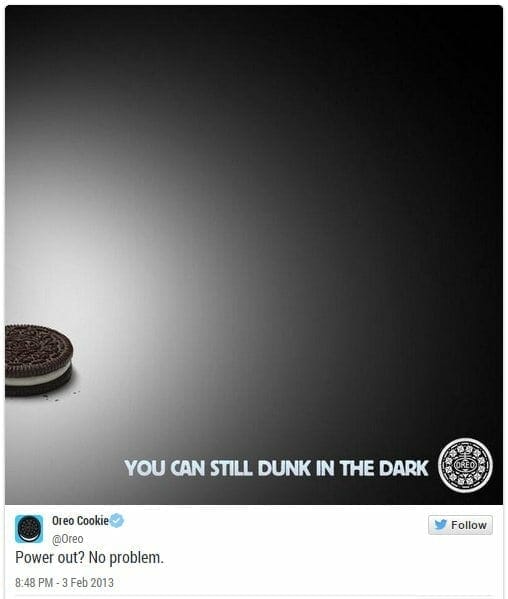
In Super Bowl XLVII in 2013, Oreo performed an extremely clever advertising tactic. During the third quarter of the game, a power outage at the Superdome caused lights to go out for 34 minutes. Oreo's social media team jumped at the opportunity by tweeting, "Power Out? No problem" with an ad of a dimly lit, lone Oreo and the caption, "You can still dunk in the dark." The response caught fire and quickly gained more than 15,000 retweets and over 20,000 likes on Facebook. 


"Once the blackout happened, no one was distracted- there was nothing going on. The combination of speed and cultural relevance propelled it to the forefront," said Sarah Hofstetter, president of digital marketing agency 360i, which handled Oreo's game day tweeting. 

A survey conducted before the game showed results that 36% of viewers would be consulting a second screen during the Super Bowl. Therefore, having a brand respond in real time on social media was a clever employment of reaching a second audience. 

"While this kind of social media campaign isn't entirely new, it's not as popular as it should be," stated Jonah Berger, a marketing professor.

So how the big question is how did Oreo pull off such a brilliant advertising tactic? The company ran their original advertisement in the first quarter of the game. Meanwhile, sources say they were equipped with a 15 person social media team, along with copywriters, strategists and an artist, ready to respond to anything that happened online regarding the Super Bowl in 10 minutes or less.      

Friday, January 26, 2018

EXTRA "Give Extra, Get Extra" Campaign

An amazing, interactive campaign sprung from a small piece of gum. Here is the full video overview of the Extra, "Give Extra, Get Extra" Campaign.

In summary, this campaign was aimed to reestablish Extra and their brand connection with their audience. They originally wanted to capitalize on the long lasting taste of the gum, but realized that they could extend the consumer's relationship with the brand by showing them the kind of social connection that could be formed via a simple piece of (Extra) gum. It started with a Love Story, of Sarah and Juan. The story follows their relationship throughout time where each memorable event was marked by a drawing on a gum wrapper. Below is just a part of the whole love story. The original video (second video) was broken into these minisode segments for different ad time allotment, and showing the consumer the progression of the story, which carried the campaign over time.


What followed was the hashtag, #GiveExtraGetExtra, and the shareable moments that were transformed into art on their very own, virtual gum wrapper. Partnered artist, Mya Pagan from Puerto Rico, was the featured artist for the gum wrappers in the short film commercial, as well as the ones created for all the audience submissions. The campaign site features an updating gallery of user submitted photos (see below) and their gum wrapper equivalent drawn by Mya. Submissions were completed by using the hashtag when posting photos to Twitter. 

http://www.giveextragetextra.com/en_US/latest-moments/call_me_trey_204
Here is a link to their campaign site to see the full gallery. 
Extra was able to utilize this user generated content to both create a bond with their existing consumers and form new ones with an audience that wanted to be a part of the gum-wrapper-writing buzz. User Generated Content is, "the act of users promoting the brand rather than the brand promoting itself," - Jose Gallegos. Gallegos does a great job of pointing out the past, and present, examples of how this kind of content has always existed. It is just getting more and more creative over the years and is able to reach a larger population thanks to all the new technology and social media outlets advertisers now have access to. When done right, a UGC Campaign can have major, positive effects on existing, or establishing, brand image.

Wednesday, January 24, 2018

SUPREME: Guerilla Advertising & Marketing


'Supreme' is a skateboard and clothing brand that was established in New York City in 1994.  Although established to gear towards skateboarders, the company has reached massive fame, receiving interest from top celebrities and even collaborating with top-notch fashion companies such as Louis Vuitton.

Only starting in 1994, there is speculation as to how a small pop up shop in New York City could reach the mainstream media with, little to no advertising campaigns. The method used by Supreme is known as Guerilla Marketing.  Guerilla marketing is defined as “an innovative, unconventional, and low-cost marketing techniques aimed at obtaining maximum exposure for a 
product.”-dictionary.com 


Supreme is essentially marketed as a 'secret society.'  The company promotes its products and brand by ‘staying under the radar.’  With only offering purchase of products during 'drop periods.'  During these drop periods, the company will allow the purchase of limited edition items through the store or online...for a very large price tag.  However, once that limited edition 'drop' ends, the company will close the ability to purchase items online.
Check Out Supreme


This Guerilla Marketing technique makes consumers feel unique and ‘special’ if they obtain a Supreme product.  This is due to the price of the product, as well as the limited supply of these products.  This technique caught the interest of many high-end celebrities such as Justin Beiber, Tyler the Creator, and Dj Khaled,  who have been seen in several pictures wearing the product.  Once, consumers see high-end celebrities wearing these items, this promotes even more ‘word of mouth’ and ‘celebrity branding’ marketing and advertising techniques. 


The advertising and marketing techniques used, promoted the brand as inclusive, rare, and unique.  Supreme has even recently collaborated with brands such as Louis Vuitton.  Overall, sometimes "less advertising" is "more advertising".  Supreme was able to use unconventional and inexpensive marketing and advertising techniques to turn a small streetwear brand into a luxury fashion brand.


Mayhem is Back

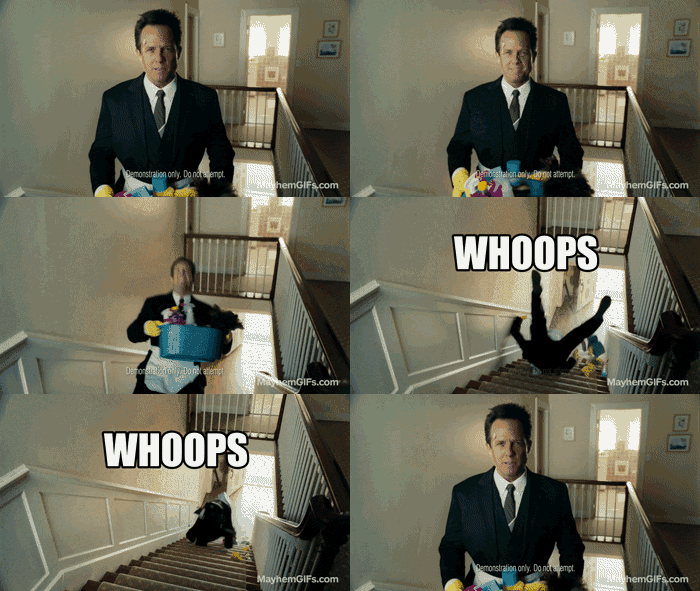
The Mayhem commercials created by Allstate are some of the most recognizable ads created. The ad's humorous character named Mayhem, portrayed by Dean Winters, is as recognizable as Flo from Progressive and the Geico Gecko. What many do not realize, though, is just how big of a part this ad played to save the company.


The company was in the aftermath of a financial crisis, and the "in good hands" campaign wasn't making a big enough impact. The company needed a thunderclap to get consumer's attention, and that was what Mayhem delivered. It was the perfect way to show people that anything could go wrong at any moment, without being scary. Instead, the Mayhem campaign focused on humor, which I find is a more memorable way to appeal to the audience. I believe this because humor makes people feel good, and because Mayhem had many different humorous scenarios, it was that much easier to get consumers to remember the commercial. The campaign has also managed to avoid becoming overused by changing the constant situations and by changing things with their latest version.


The newest campaign featuring Mayhem features the character having a new years resolution. Deciding to protect people rather than cause destruction by being a road fare or a lightning rod. Of course, when others can't keep their resolutions, Mayhem comes back with all his destructive hijinks. I found this to be a refreshing twist, and it made the commercial even more memorable. This is why, in my opinion, Mayhem will be known as one of the most recognizable campaigns created.